

-

97 Auto Road, County of Vermilion River, AB T0B 0L0
-

-

97 Auto Road, County of Vermilion River, AB T0B 0L0
In 2026, global buyers need more than a long supplier list when choosing Aramid Honeycomb Tools. They need verified performance, practical compatibility, and clear evidence from real production environments. Aramid honeycomb cores are lightweight, stiff, and sensitive to crushing. Tool selection therefore affects edge quality, dust control, cycle time, and final panel reliability.
Dr. Stephen W. Tsai, a respected composites researcher, has said, “Composites are not a material, but a design concept.” This principle remains valuable for buyers comparing cutting blades, routers, drills, scoring tools, and specialized trimming systems. The best option depends on core density, cell size, adhesive condition, panel thickness, and the required surface finish. A tool that performs well on Nomex honeycomb may behave differently on another aramid structure. Small differences matter.
This guide evaluates Aramid Honeycomb Tools through an engineering and purchasing perspective. It considers cutting precision, tool life, operator safety, maintenance demands, delivery support, and supplier documentation. Samples should be tested before large orders. That step is easy to skip. It is also where many avoidable mistakes begin. No ranking is perfect, because factory conditions vary across regions and applications. Still, transparent criteria can make comparison more reliable. Buyers should question impressive claims, request test data, and inspect finished edges under realistic workloads. The strongest choice is not always the cheapest or fastest tool. It is the tool that delivers repeatable results without damaging the fragile honeycomb structure.
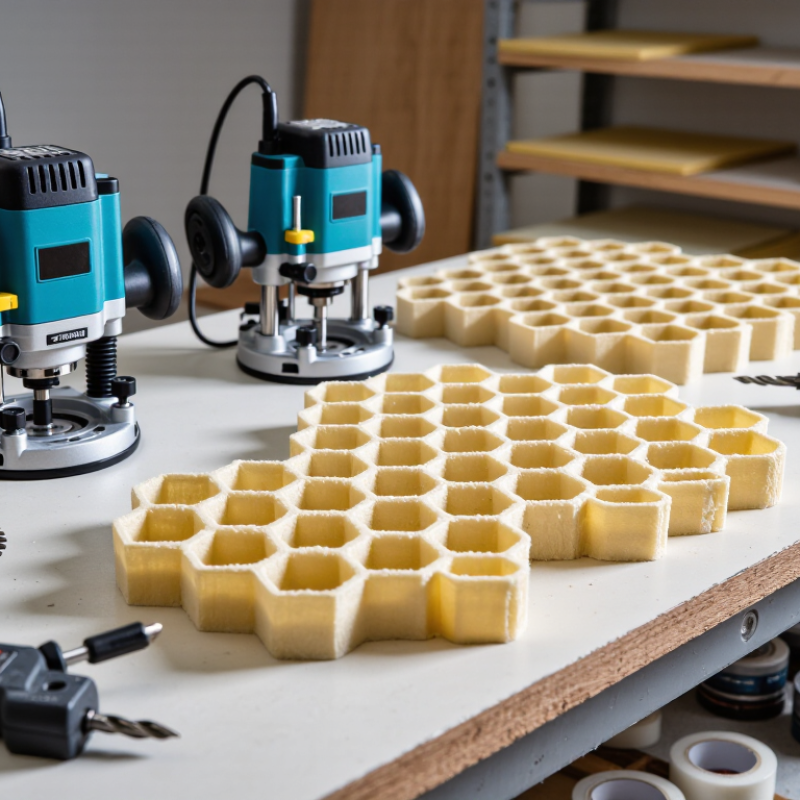
2026 Best Aramid Honeycomb Tools for Global Buyers
Aramid honeycomb is selected by density and cell size, not appearance alone. Common densities range from 29 to 160 kg/m³. Cell sizes often run from 3 to 10 mm. Lower densities reduce weight but may limit compression strength. Higher densities usually improve stiffness and impact resistance. However, they can increase machining effort and total cost. A 3 mm cell provides finer support for thin skins and curved panels. A 10 mm cell may suit larger sandwich structures with less detailed geometry. The wrong match can create weak bonding or uneven panel surfaces.
During material evaluation, buyers should request compression, shear, flatwise tension, and resin uptake data. Test direction matters. So does moisture conditioning. Production trials should check cutting dust, edge crush, adhesive spread, and curing temperature. Aramid cores can appear consistent while showing small density variations between batches. That detail is easy to miss. It should not be ignored. Technical documents must identify core thickness, tolerance, cell direction, fire behavior, and inspection methods. Independent testing adds confidence when projects cross borders or involve multiple fabricators.
Tips: Compare two densities with the same cell size before ordering volume. Cut a sample panel and inspect the bond line after curing. Ask for batch records and test dates. Do not choose the lightest core automatically. It may save shipping weight, yet increase rework later. I would also allow a small trial margin, because laboratory results rarely mirror every workshop condition.
A practical, brand-neutral comparison of aramid honeycomb core grades, cell sizes, fabrication tools, and verification methods for lightweight sandwich structures.
| Category | Representative Specification | Typical Use or Result | Buyer Selection Guidance |
|---|---|---|---|
| Ultra-light core | 29–48 kg/m³ 3–6 mm nominal cell size | Low-load interior panels, fairings, doors, covers, and non-structural cabin components. | Choose when minimum mass is the primary objective and the panel has adequate face-sheet stiffness and local reinforcement. |
| Light structural core | 48–80 kg/m³ 3–6 mm or 6–10 mm cell size | General aerospace, rail, marine, and transport sandwich panels requiring a balance of weight, shear support, and processability. | A suitable starting range for many lightweight panels; confirm compression, shear, and flatwise tensile properties for the final design. |
| Medium-density core | 80–120 kg/m³ 3–6 mm nominal cell size | Floor panels, equipment platforms, access panels, bulkheads, and areas exposed to higher concentrated loads. | Use where improved core stability and local load resistance are more important than the lowest possible core mass. |
| High-density core | 120–160 kg/m³ 3–6 mm nominal cell size | High-load panels, hard points, heavy-duty partitions, and regions requiring greater compressive and shear capability. | Verify that the additional core mass is justified; use inserts or local doublers when loads are highly concentrated. |
| Fine cell option | 3–4 mm Usually selected with medium or high density | Improved surface conformity, better support for thin face sheets, and reduced risk of print-through on curved panels. | Preferred for tighter radii, thin skins, detailed contours, and applications where surface quality is important. |
| General-purpose cell option | 5–6 mm Broad processing range | Common compromise between drape, resin access, panel weight, and fabrication efficiency. | Use for flat or moderately curved panels when no special contouring requirement dominates the design. |
| Coarse cell option | 8–10 mm Often used with lower or medium density | Large-area panels where fast cutting, low core mass, and efficient material coverage are priorities. | Check face-sheet stability, unsupported span, local indentation, and surface telegraphing before specifying a coarse cell. |
| Hot-wire or heated blade cutter | Temperature-controlled cutting system; clean, non-crushing contact | Fast trimming of straight edges and repeatable cutting of honeycomb blocks or sheets. | Use controlled heat and ventilation appropriate to the resin system; avoid excessive heat that can damage cell walls or contaminate bonding surfaces. |
| Band saw or fine-tooth saw | Fine blade, rigid guide, dust extraction, and adjustable feed rate | Accurate straight cuts, thickness reduction, and preparation of larger core sections. | Support the core continuously during cutting to reduce tearing, crushing, and out-of-square edges. |
| Oscillating knife or CNC knife cutter | Programmable cutting path with low-force oscillating blade | Repeatable profiles, apertures, curved edges, and nesting of multiple panel shapes. | Best for clean, low-compression cutting; use sacrificial backing and verify kerf compensation for tight tolerances. |
| Router with dust extraction | Sharp carbide tooling, shallow passes, controlled spindle speed | Edge trimming, pockets, rebates, scarf preparation, and insert cavities. | Use light passes and full extraction because aggressive routing can fracture cell walls and generate fine particulate. |
| Core splicing and joining tool | Alignment jig, low-pressure roller, and compatible film or paste adhesive | Joins smaller core pieces into larger panels while maintaining cell alignment. | Control adhesive quantity and cure conditions; excessive adhesive adds mass and may restrict cell drainage or ventilation. |
| Core contouring tool | Contour jig, compression fixture, or controlled kerf-cutting setup | Forms aramid honeycomb to single-curvature or compound-curvature surfaces. | Match the method to cell size and density; fine cells generally conform more easily, while high-density cores require higher forming control. |
| Adhesive application equipment | Notched spreader, metering roller, or calibrated dispensing system | Applies film, paste, or liquid adhesive uniformly to the core or face sheets. | Follow the adhesive supplier’s recommended film weight, open time, pressure, and cure schedule; avoid over-wetting the core. |
| Vacuum-bagging equipment | Vacuum pump, bag film, breather, release film, sealant tape, and vacuum gauge | Provides uniform consolidation during bonding and reduces voids in sandwich laminates. | Check leak rate before cure and use a pressure level compatible with the core, face sheets, and tooling configuration. |
| Compression or cure fixture | Flat, dimensionally stable tool with controlled pressure and temperature | Maintains panel thickness, alignment, and bond-line consistency during adhesive curing. | Provide adequate caul support and avoid localized pressure that can crush the honeycomb cells. |
| Dimensional inspection tools | Calipers, thickness gauge, straightedge, angle gauge, and digital scale | Checks core thickness, cell size, squareness, mass per unit area, and finished-panel dimensions. | Measure several locations because honeycomb thickness and cell geometry can vary across a sheet or block. |
| Density verification | Conditioned specimen, precision balance, and measured volume | Determines apparent core density using mass divided by volume. | Record specimen dimensions, moisture or conditioning state, and whether adhesive, coating, or scrim is included. |
| Compression test reference | ASTM C365/C365M or an equivalent validated method | Measures flatwise compressive strength and modulus of sandwich core material. | Use the same specimen orientation, conditioning, and reporting basis when comparing different density grades. |
| Shear test reference | ASTM C273/C273M or an equivalent validated method | Measures core shear strength and shear modulus in the selected direction. | Important for floors, beams, panels, and components where face sheets transfer bending loads through the core. |
| Sandwich flexural test reference | ASTM C393/C393M or an equivalent validated method | Evaluates the bending response of the complete face-sheet/core sandwich construction. | Test the actual face-sheet, adhesive, core density, cell size, and thickness combination rather than relying only on core data. |
| Bond integrity inspection | Visual inspection, tap testing, ultrasonic inspection, or thermography | Detects disbonding, voids, crushed zones, resin starvation, and incomplete adhesive transfer. | Select the inspection method according to panel thickness, skin material, accessibility, and required quality level. |