

-

97 Auto Road, County of Vermilion River, AB T0B 0L0
-

-

97 Auto Road, County of Vermilion River, AB T0B 0L0

Choosing the best Pneumatic Calibrator in China requires more than comparing prices or advertised accuracy. A reliable choice must fit the pressure range, working environment, and verification procedure. MarketsandMarkets reported that the global calibration services market was valued at approximately USD 4.4 billion in 2023. It also projects continued growth through 2028, driven by stricter quality controls and industrial automation. This trend reflects a practical reality: calibration equipment now supports production decisions, not only laboratory checks.
A strong Chinese Pneumatic Calibrator should offer stable pressure generation, fine adjustment, and clear measurement records. For example, a technician may need to verify a 6-bar pneumatic transmitter beside a noisy compressor line. In that situation, resolution, leak resistance, and readable display performance matter immediately. ISO/IEC 17025 emphasizes competent calibration laboratories, valid methods, and traceable measurement results. Therefore, buyers should review calibration certificates, uncertainty statements, sensor specifications, and service procedures before purchase. Brand reputation helps. Evidence matters more.
There is no universal winner. That answer would be too simple. A portable hand-pump calibrator may suit field maintenance, while a pneumatic comparison test pump may perform better in workshops. NIST guidance on pressure measurement also highlights the importance of traceability, environmental conditions, and uncertainty evaluation. Chinese manufacturers differ in sensor quality, software support, documentation, and replacement-part availability. Some products look impressive on paper but feel less stable after repeated pumping. This is where experience changes the decision. The best model is the one that remains accurate, serviceable, and properly documented throughout its real operating life. Market reports provide direction, but hands-on verification should decide the final purchase.
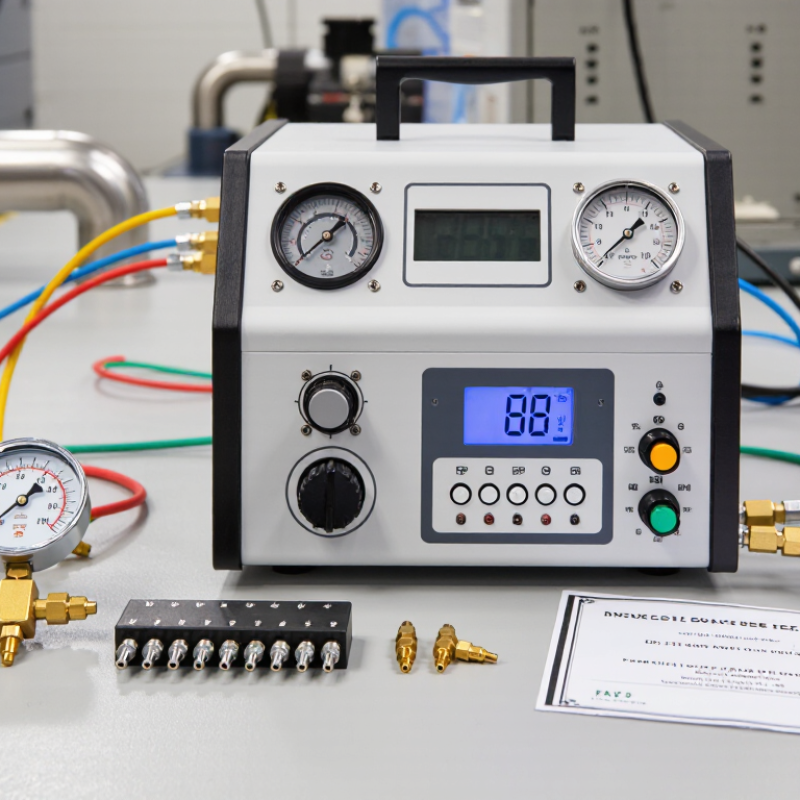
A pneumatic calibrator is a portable instrument used to generate, measure, and verify air pressure. It usually combines a hand pump, reference sensor, adjustment valve, and digital display. Technicians connect it to pressure switches, transmitters, gauges, or control systems. The calibrator then creates a controlled pressure, such as 1 bar or 10 bar, while comparing the device reading with its reference value.
According to the U.S. Department of Energy’s compressed-air guidance, leaks and poor maintenance can waste 20–30% of compressor output. That makes dependable pressure verification important in factories, laboratories, and maintenance workshops. ISO/IEC 17025:2017 also stresses traceability, measurement uncertainty, and documented calibration procedures. In China, the best pneumatic calibrator should match the working range, accuracy requirement, medium, and local service capability. A wider range is not always better. It may reduce resolution. This is easy to overlook.
Tips: Check the certificate, resolution, overpressure protection, and leak-tight connections. Test the calibrator against a traceable reference before critical work. Record ambient temperature and pressure. Small errors can grow during field use. A practical mistake is choosing specifications from a brochure alone; real fittings, tubing, and operator technique also affect results.
| Pneumatic Calibrator Type | How It Works | Typical Pressure Range | Typical Accuracy | Pressure Medium | Common Applications | Main Advantages | Important Limitations |
|---|---|---|---|---|---|---|---|
| Low-Pressure Pneumatic Hand Pump | Uses a manual pump and fine adjustment valve to create and stabilize low pressure or vacuum. | Approximately -1 to 1 bar, depending on configuration | Typically 0.1% to 0.25% of full scale when used with a suitable reference gauge | Clean, dry air or other compatible gas | Differential-pressure transmitters, air-handling equipment, laboratory instruments, and low-pressure switches | Portable, economical, and suitable for field testing | Manual operation; pressure stability and output depend on the operator |
| Pneumatic Pressure Hand Pump | Generates positive pressure through a piston or lever mechanism, with a bleed valve for fine control. | Approximately 0 to 40 bar for common field models | Typically 0.1% to 0.25% of full scale, depending on the reference instrument | Air or nitrogen | Pressure gauges, pressure switches, transmitters, and process instrumentation | Easy to carry and does not require electrical power | Not ideal for high-volume testing or applications requiring automatic control |
| High-Pressure Pneumatic Hand Pump | Uses a multi-stage pumping mechanism to generate higher pneumatic pressure for calibration checks. | Approximately 0 to 700 bar in specialized configurations | Typically 0.1% to 0.25% of full scale; the complete system accuracy is limited by the reference standard | Dry air or nitrogen where permitted by the equipment under test | High-pressure gauges, pressure transmitters, safety devices, and industrial test benches | Provides high pressure without a powered compressor | Requires more effort, careful connections, and appropriate pressure-rated components |
| Digital Pneumatic Pressure Calibrator | Combines a pneumatic pressure source with a digital reference sensor and electronic pressure display. | Commonly -1 to 40 bar, with wider ranges available | Typically 0.025% to 0.1% of full scale | Clean, dry air or nitrogen | Calibration of gauges, transmitters, switches, and pressure sensors | Improved readability, data recording, unit conversion, and portable operation | Requires battery maintenance and periodic sensor calibration |
| Automatic Pneumatic Pressure Calibrator | Uses a pressure controller, internal sensor, and control software to generate and maintain programmed test points. | Often from vacuum to 20 bar; the available range depends on the pressure controller | Typically 0.005% to 0.05% of full scale | Clean, dry air or nitrogen | Production testing, calibration laboratories, automated test systems, and multi-point verification | Fast, repeatable, programmable, and less dependent on operator technique | Higher purchase cost, greater system complexity, and a need for a stable gas supply |
| Pneumatic Temperature and Pressure Calibrator | Integrates a pneumatic pressure source with temperature simulation or measurement functions. | Pressure range commonly up to 20 to 40 bar; temperature range depends on the integrated module | Pressure accuracy commonly 0.025% to 0.1% of full scale; temperature accuracy varies by sensor type | Air or nitrogen for pressure generation | Combined testing of pressure transmitters, temperature transmitters, and Process Calibrators | Reduces the number of instruments needed for field service | More functions can increase setup time and calibration requirements |