

-

97 Auto Road, County of Vermilion River, AB T0B 0L0
-

-

97 Auto Road, County of Vermilion River, AB T0B 0L0

Choosing the China Best Airport Escalator Spare Parts Supplier requires more than comparing prices. Airport escalators operate for long hours, carry heavy passenger flows, and face dust, humidity, vibration, and sudden temperature changes. A weak component can create delays, safety concerns, and expensive emergency work.
David Cooper, Managing Director of LECS (UK) and a respected lift and escalator consultant, has stated, “A spare part is only valuable when it restores safe, reliable operation.” This principle matters when evaluating Airport Escalator Spare Parts. A dependable supplier should provide accurate dimensions, compatible materials, stable production, and clear inspection records. Parts such as step chains, rollers, handrail belts, comb plates, bearings, drive components, and safety switches need careful verification. One small mismatch may cause noise, uneven movement, or premature wear.
Look beyond the catalogue.
The strongest Chinese suppliers usually support model identification, technical drawings, sample approval, and batch traceability. They should explain whether each part is original, OEM-equivalent, or aftermarket. Certificates and test reports also deserve attention, although paperwork alone cannot prove field performance. Real experience matters. Ask about airport projects, replacement timelines, packaging methods, and after-sales support.
No supplier is perfect. Some product pages may appear professional but lack useful engineering detail. That is a warning sign. A better choice combines manufacturing capability with honest communication and practical maintenance knowledge. This guide examines how to compare Chinese suppliers, reduce procurement risks, and select Airport Escalator Spare Parts that support safe, continuous airport operations.
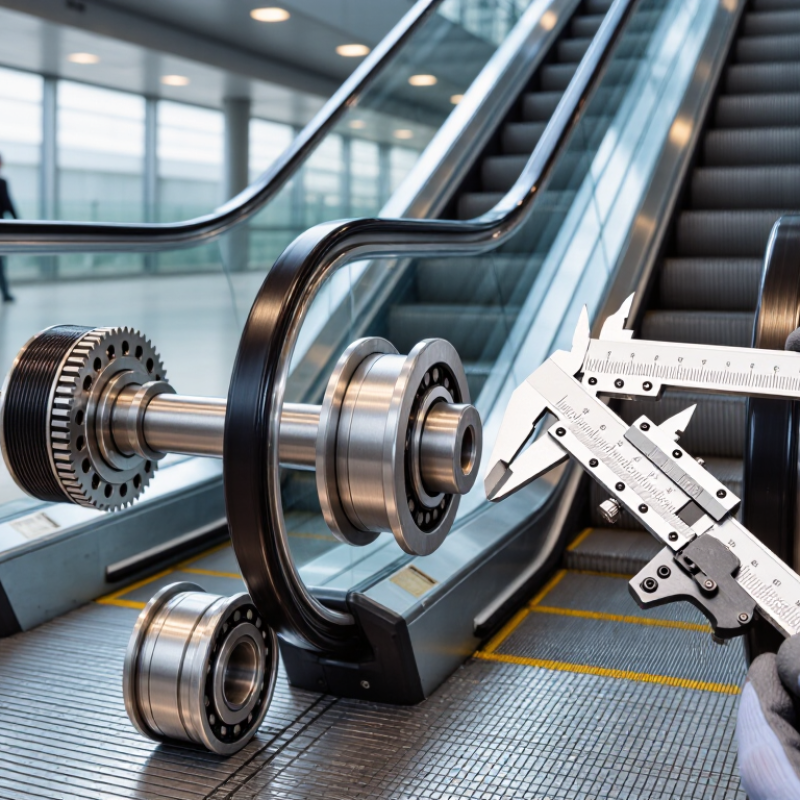
China Best Airport Escalator Spare Parts Supplier?
Understanding Airport Escalator Spare Parts and Their Applications
Airport escalators operate under constant passenger pressure. ACI World’s 2024 Airport Traffic Forecast recorded 8.5 billion global passengers in 2023. This traffic creates demanding conditions for steps, step chains, handrail belts, rollers, comb plates, sensors, and brake components. Each part serves a specific safety function. Step chains transfer movement. Comb plates reduce gaps near landings. Sensors detect abnormal speed, obstruction, or alignment. In practice, dust and spilled liquids can accelerate wear. Heavy luggage can also damage rollers and entry panels.
Reliable spare parts require accurate measurements and documented compatibility. Maintenance teams should check dimensions, material hardness, electrical ratings, and operating temperature. EN 115-1 and ASME A17.1 provide important safety references for escalator design and maintenance. However, standards do not replace site experience. An apparently suitable roller may produce vibration when its shaft tolerance is wrong. This is where supplier inspection, sample testing, and traceable quality records matter. A perfect plan can still fail when old equipment drawings are incomplete.
Tips: Photograph every removed part. Record its location and failure mode. Request material certificates and inspection reports. Test handrail speed, braking response, and sensor operation after installation. Keep critical parts in clean, dry storage. Do not assume the cheapest component offers the lowest lifecycle cost. Biannual reviews may reveal repeated failures, but airport-specific maintenance data should guide the final interval.
A practical reference for identifying airport escalator spare parts, their functions, common materials, and maintenance applications.
| Spare Part | Primary Function | Common Materials or Construction | Typical Airport Application | Inspection Focus | Replacement Considerations |
|---|---|---|---|---|---|
| Escalator Steps | Carry passengers between different floor levels while maintaining a continuous, interlocked walking surface. | Die-cast aluminium or formed metal with longitudinal grooves and yellow step demarcation lines. | Terminal halls Concourse links Baggage areas | Cracks, deformation, missing demarcation lines, damaged rollers, abnormal noise, and correct step alignment. | Match step dimensions, axle spacing, roller position, groove pattern, and system configuration before ordering. |
| Step Rollers | Guide and support each step along the track system and help reduce rolling resistance. | Steel or engineered polymer wheels with sealed or shielded bearings, depending on the assembly design. | High-cycle escalators operating continuously during passenger peak periods. | Flat spots, bearing noise, excessive play, uneven rotation, heat, and track contact marks. | Replace worn rollers in accordance with the maintenance schedule and inspect the associated axles and tracks. |
| Step Chain | Connects the steps and transfers drive force through the escalator loop. | Precision-manufactured alloy-steel links, pins, bushings, and rollers with corrosion-resistant lubrication requirements. | Long-rise installations and heavily used terminal escalators subject to frequent load cycles. | Elongation, stiff links, corrosion, inadequate lubrication, abnormal vibration, and uneven tension. | Use the correct pitch, link arrangement, roller dimensions, and rated load; chain replacement normally requires alignment checks. |
| Drive Chain | Transfers torque from the gearbox or drive output to the step-chain sprocket or main drive assembly. | Industrial roller-chain construction using hardened steel links, pins, bushes, and rollers. | Escalators and moving walks with high daily operating hours. | Chain elongation, sprocket wear, excessive slack, lubrication condition, vibration, and unusual mechanical noise. | Replace the chain and inspect sprocket tooth profiles when elongation or wear exceeds the equipment manufacturer’s limits. |
| Drive Sprocket | Engages the drive chain or step chain and converts rotational motion into step movement. | Machined or forged alloy steel, often with a hardened or treated tooth surface. | Drive stations exposed to repeated starting, stopping, and passenger loading cycles. | Hooked or sharpened teeth, uneven wear, cracks, runout, loose keys, and incorrect chain engagement. | Confirm tooth count, pitch, bore, keyway, rotation direction, and shaft dimensions before replacement. |
| Handrail Belt | Provides passengers with a moving handhold synchronized with the escalator steps. | Multi-layer elastomer construction with internal reinforcement and a low-friction guide surface. | Public-facing areas where hygiene, passenger comfort, and continuous availability are important. | Cracks, glazing, stretching, surface cuts, tracking problems, speed mismatch, and excessive tension. | Verify belt length, profile, guide dimensions, direction of travel, and compatibility with the handrail drive system. |
| Handrail Drive Wheel | Maintains handrail movement and helps synchronize the handrail speed with the steps. | Rubber-coated or high-friction polymer wheel mounted on a metal hub or drive assembly. | Escalators with long handrail paths or intensive daily passenger use. | Surface hardening, slipping, uneven wear, bearing noise, poor tracking, and speed deviation. | Inspect the wheel, pressure setting, guide rollers, and handrail condition together rather than replacing only one worn component. |
| Comb Plate | Bridges the transition between the moving steps and the landing floor while reducing the gap at the landing. | Cast or machined aluminium, stainless steel, or other approved metal with replaceable comb teeth. | Boarding and exiting points of terminal escalators and moving walks. | Broken or bent teeth, incorrect clearance, loose fasteners, contamination, and damaged yellow warning markings. | Use the correct tooth profile and landing geometry; comb impact devices must be tested after installation. |
| Comb Impact Safety Device | Detects excessive force or obstruction at the comb area and initiates a safety stop. | Mechanical trigger assembly with electrical switching elements and adjustable mounting hardware. | High-traffic landings where footwear, luggage, or foreign objects may reach the comb area. | Correct activation force, switch response, reset operation, wiring condition, and secure mounting. | Functional testing is required after replacement; never bypass the device during normal operation. |
| Skirt Panel | Forms the side boundary beside the steps and helps prevent access to internal moving components. | Stainless steel, coated steel, or other rigid metal panels with smooth, cleanable surfaces. | Passenger-facing areas requiring durability, cleanability, and resistance to frequent contact. | Dents, sharp edges, corrosion, loose fixings, excessive step-to-skirt clearance, and surface contamination. | Check panel thickness, curvature, fixing locations, finish, and required clearance from the steps. |
| Skirt Deflector Brush | Creates a visual and physical boundary that discourages passengers from placing footwear or objects against the skirt. | Flexible nylon or similar synthetic bristles fixed to an aluminium or polymer carrier. | Passenger escalators in busy terminals, transfer corridors, and public concourses. | Missing bristles, loose carrier sections, contamination, poor alignment, and interference with steps. | Confirm brush height, carrier profile, fixing method, and continuous coverage along the required skirt section. |
| Balustrade Panel | Provides a transparent or solid barrier beside the handrail and protects passengers from moving mechanisms. | Tempered safety glass, laminated safety glass, or approved transparent polymer panels with metal supports. | Terminal interiors where visibility, passenger guidance, and architectural integration are required. | Chips, cracks, loose clamps, damaged seals, panel movement, and incorrect edge clearances. | Confirm thickness, dimensions, hole positions, edge treatment, safety-glazing specification, and support hardware. |
| Emergency Stop Button | Allows passengers or authorized personnel to stop the escalator quickly during an emergency. | Red latching push button with a protective bezel and electrical contact block. | Accessible at escalator entrances, exits, and other locations specified by the safety design. | Visibility, accessibility, latching action, contact operation, reset procedure, labels, and enclosure condition. | Test the complete stop circuit and reset sequence after replacement; use the approved contact arrangement. |
| Safety Switches | Monitor conditions such as overspeed, broken drive components, access-panel opening, step loss, or handrail entry obstruction. | Industrial electromechanical switches, proximity sensors, or position switches with protected cabling. | Safety circuits throughout the truss, drive station, landing, skirt, and handrail entry zones. | Actuator position, contact continuity, cable damage, corrosion, false trips, and correct fail-safe operation. | Identify the monitored function and contact logic before installation; test the safety circuit under controlled conditions. |
| Gearbox Seals and Bearings | Maintain lubricant containment and support rotating shafts inside the drive transmission. | Oil-resistant elastomer seals and precision rolling bearings selected for the gearbox design. | Drive units operating for extended periods with frequent starts, stops, and changes in passenger load. | Oil leakage, temperature rise, vibration, unusual sound, shaft play, and lubricant contamination. | Confirm shaft size, seal profile, bearing clearance, lubricant type, and alignment requirements before service. |
| Controller and Relay Components | Manage motor starting, stopping, monitoring, fault handling, lighting, and communication with safety circuits. | Electrical control modules, relays, contactors, terminal blocks, sensors, and protected wiring assemblies. | Airport facilities requiring reliable operation, fault indication, and integration with building maintenance procedures. | Loose terminals, overheating, contact wear, insulation damage, fault codes, and correct input/output signals. | Match voltage, current rating, control logic, terminal layout, enclosure requirements, and approved software configuration. |
| Step Demarcation Inserts | Improve visual awareness of step edges and help passengers identify the boundaries of each moving step. | High-visibility yellow polymer or approved coating integrated into or attached to the step surface. | Boarding and exit zones with heavy passenger flow and varied lighting conditions. | Fading, peeling, missing sections, contamination, poor contrast, and damage caused by cleaning equipment. | Use a compatible insert or coating that does not create a raised edge or interfere with step clearances. |