Top FBE Coated LSAW Steel Pipe Factory for Global Buyers
For global buyers, choosing the right FBE coating LSAW steel pipe factory can shape a project’s long-term performance. These pipes support water transmission, energy infrastructure, and industrial construction. Their reliability depends on more than a strong steel grade. It also depends on welding control, surface preparation, coating application, and traceable inspection.
Experienced manufacturers understand these practical demands. They manage plate forming, submerged arc welding, dimensional checks, and pressure testing with defined procedures. The FBE coating process requires careful blasting, controlled temperature, and even powder application. A coating may look smooth but still contain hidden weaknesses. Small details matter. Improper surface cleanliness can reduce adhesion, especially in wet or buried environments.
A credible factory supports its claims with measurable evidence. Inspection may include weld radiography, ultrasonic testing, coating thickness checks, adhesion testing, and holiday detection. Each pipe should connect with material certificates, production records, and inspection reports. Before shipment, buyers should confirm diameter, wall thickness, coating grade, packing method, and export documentation.
Clear communication also reveals professional experience. Good suppliers explain limitations instead of promising everything. No factory should pretend that every project is identical. Soil conditions, operating pressure, temperature, and installation methods can change the specification. This point is easy to overlook.
For international purchasing teams, dependable service means consistent quality, responsive engineering support, and realistic delivery planning. A capable FBE coating LSAW steel pipe factory does not only sell finished pipe. It helps buyers reduce uncertainty, verify performance, and make informed infrastructure decisions. Mistakes can still happen, but transparent controls make them easier to prevent and correct.
FBE-Coated LSAW Steel Pipe: Definition and Core Features
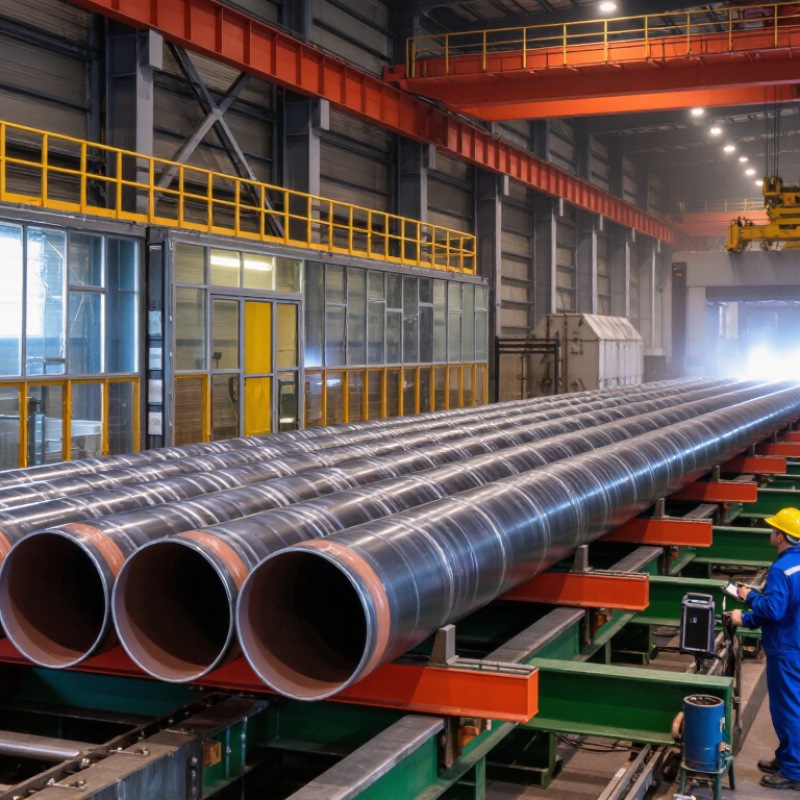
FBE-coated LSAW steel pipe is longitudinally submerged-arc-welded pipe protected by a fusion-bonded epoxy layer. The pipe is heated, coated with charged epoxy powder, then cooled to form a hard, continuous film. It helps limit corrosion from soil moisture and many common chemicals. It is a barrier, not structural reinforcement.
Industry specifications commonly call for a dry-film thickness around 300–500 micrometres, though project requirements vary. ISO 21809-2:2014 sets qualification and testing requirements for external FBE pipeline coatings, including adhesion, impact, and cathodic-disbondment performance. Thickness alone is not proof of quality. On LSAW pipe, inspectors should check coating continuity around the weld seam, pipe ends, and handling marks. Holiday testing can reveal tiny gaps that visual checks may miss. Small defects matter.
A practical factory record should link thickness readings, test results, and pipe identification. This makes later inspection more useful. One caveat: FBE does not protect uncoated field joints automatically. Those areas need a compatible coating system, and poor surface preparation can undermine an otherwise sound coating. Even good factory control has limits.
How LSAW Steel Pipes Are Manufactured and Formed
LSAW steel pipe begins as a wide steel plate, not a coil. The plate edges are milled and its ends pre-bent to reduce gaps during forming. In the UOE route, presses shape the plate into a U and then an O; mechanical expansion helps improve roundness. JCOE forming bends the plate through successive J, C, and O stages. The sequence matters. World Steel Association’s World Steel in Figures 2024 reports 1,892.2 million tonnes of crude steel production in 2023, the upstream scale behind products such as pipeline plate.
After forming, submerged arc welding joins the longitudinal seam from inside and outside. Operators then check welds using nondestructive examination, measure dimensions, and conduct pressure tests according to the purchase specification. API Specification 5L sets requirements for line pipe, including manufacturing and inspection; actual acceptance criteria depend on the ordered grade and product level. One detail is easy to underestimate: plate chemistry and forming conditions can affect weldability and dimensional consistency. It is worth checking both, not just the final test record. For FBE-coated pipe, the surface is cleaned and prepared before powder is applied and cured. Coating inspection matters too, since a sound pipe can still be vulnerable where coverage is thin or damaged.
Top FBE-Coated LSAW Steel Pipe Factory for Global Buyers
How LSAW steel pipes are manufactured and formed: the chart compares representative standard nominal pipe sizes by outside diameter.
LSAW pipe production typically forms a steel plate into a cylinder, welds the longitudinal seam, and then performs sizing and inspection. Fusion-bonded epoxy (FBE) is applied as a protective coating. The diameters shown are standard outside-diameter values for the listed NPS sizes, not production-capacity figures.
The FBE Coating Process and Quality Control Standards
A reliable FBE coating begins before the powder reaches the pipe. Mill operators remove oil and rust, then abrasive-blast the steel to Sa 2½ cleanliness under ISO 8501-1. They check surface profile and dust because contamination can weaken adhesion. The pipe is heated within the qualified procedure’s range, and charged epoxy powder is applied evenly. Cure time and temperature matter. A cold area may leave the coating under-cured; excess heat can damage it. Small defects matter.
Quality control continues after cooling. Inspectors measure coating thickness at several points, then use holiday detection to locate pinholes that a visual check can miss. Adhesion, impact resistance, and cathodic-disbondment testing are included in the qualification framework of ISO 21809-2:2014. Production records should link test results to pipe numbers, temperatures, and powder batches. The 2016 IMPACT study by NACE International estimated corrosion costs at US$2.5 trillion worldwide, or 3.4% of global GDP, and reported potential savings of 15–35% through corrosion-control practices. That figure is broad, not an FBE-specific saving. Still, it shows why repeatable inspection matters. Real mills also face imperfect surfaces and schedule pressure; documenting repairs and retests is as important as passing the first check.
Key Applications and Benefits for Global Buyers
FBE-coated LSAW steel pipe is used in large-diameter water, oil, gas, and industrial transmission lines. Its longitudinal weld construction suits many projects requiring long pipe sections and controlled strength. The fusion-bonded epoxy layer forms a protective barrier against soil moisture and corrosive conditions. That matters. NACE International’s IMPACT study estimated corrosion costs at US$2.5 trillion annually, or 3.4% of global GDP. The figure covers many industries, not pipelines alone, but it shows why corrosion control deserves attention.
For global buyers, the coating can reduce maintenance exposure when the system is correctly specified, handled, and inspected. The IEA’s Global Hydrogen Review 2024 tracks about 40,000 km of announced hydrogen pipeline projects; many are still at planning stages. This points to potential demand for transport infrastructure, not guaranteed orders. Buyers should check coating thickness, holiday-test results, surface preparation, and compatibility with cathodic protection. Those details matter at field joints and after rough transport. A good coating cannot fix poor installation. Nor does one specification fit every soil, fluid, or operating temperature. Even experienced teams can miss damage during handling, so inspection plans need to be practical, not just thorough on paper.
How to Evaluate and Select a Reliable FBE Pipe Factory
Selecting a reliable FBE coated LSAW steel pipe factory requires more than comparing prices. Start with its production records, welding procedures, and experience with large-diameter line pipe. A dependable factory should explain steel plate sourcing, forming accuracy, submerged arc welding, and heat treatment clearly. Ask for recent project references and measurable quality data.
Visit the coating line if possible. Look for controlled surface preparation, abrasive cleanliness, preheating, and uniform epoxy application. Coating thickness should be checked at several points, not only near the pipe ends. Request test reports for adhesion, holiday detection, impact resistance, and cathodic disbondment. Independent inspection can add useful confidence. It also exposes weak documentation.
Traceability matters. Each pipe should connect to a heat number, weld record, coating batch, and inspection result. Check whether the factory uses calibrated gauges and keeps records after shipment. Review packing methods, marking, loading photos, and delivery performance.
Communication is another practical test. Technical answers should be specific, not decorative. A low quotation may conceal thinner coating or incomplete testing. No factory is perfect. Even a capable supplier may have delays or occasional repairs. Ask how it handles nonconforming pipes, corrective action, and customer complaints. A factory worth trusting welcomes these questions and provides evidence instead of promises.